Metaphysical Noir Fiction: Uncovering the Liminal Space
Welcome to a journey through one of the most mysterious areas in modern books. We are looking at a unique genre that lives in the shadows between our physical world and the unknown. This is where grit meets the soul.
This kind of writing takes us to a compelling place. It is not a fluffy heaven or a pit of fire, but a threshold where every story asks big questions. You are entering a zone where moral choices carry weight far beyond the grave.
Authors like Ralph Riccie use this way of storytelling to explore the human condition. His background in finance helps him craft a grounded drama that feels incredibly real. He looks at the past to understand how it shapes our time here and hereafter.
Many people feel the power of these narratives because they offer different ways to see the end of life. These tales refuse to give easy answers. Instead, the atmospheric tension stays in your head long after you finish the last page.
Dealing with things like love and loss requires a very special touch. This Metaphysical Noir Fiction invites you to think deeply about your own existence. It is a path toward understanding the complexity of the in-between through a dark and moody lens.
Key Takeaways
- Discover the intersection where detective mystery meets deep philosophy.
- Explore the liminal space as a setting for complex moral growth.
- Understand how Ralph Riccie brings financial realism to moody narratives.
- Move beyond clichéd versions of the afterlife to find deeper meaning.
- Learn why mortality and consciousness are the heart of this style.
- Find out why atmospheric tension helps us process life's biggest mysteries.
What Is Metaphysical Noir Fiction?
Metaphysical noir fiction represents a sophisticated fusion where the hard-edged realism of classic stories meets deep inquiries about existence. It is a unique kind of fiction that explores the nature of human consciousness and reality. This genre does more than just track down a suspect in the dark; it searches for the meaning behind the shadows.
Defining the Metaphysical Element
The metaphysical side of a novel does not take you to a fantasy land or a distant future. Instead, it uses a world we already know and adds layers of hidden meaning. Events in the story become symbols of psychological truths or moral dilemmas that the protagonist must face.
"Truly metaphysical literature goes further and dramatizes the encounter between mind and reality, the liquid mysteries of thought, pattern, and form."
— Novelist Greg Jackson
The Noir Foundation
Classic film conventions provide the sturdy bones for this style of writing. You will find characters with broken moral compasses and a city that feels like a living, breathing person. These novels use an atmosphere of alienation to show the darker corners of human life.
Where These Worlds Collide
When these styles merge, the crime is no longer just a plot point for a novelist to solve. It becomes a way for the author to ask if any one choice truly matters over a long period of time. This narrative approach gives the reader a work that feels both exciting and deeply thoughtful.
In this space, the detective’s journey mirrors our own search for significance in a chaotic universe. There is a lot to learn when a mystery forces us to look inside ourselves rather than just at the evidence. Every great novel in this space leaves you questioning what you know about life.
| Element | Traditional Noir Focus | Metaphysical Noir Focus |
|---|---|---|
| The Mystery | Who committed the crime? | Why does reality exist? |
| The Setting | Rainy urban streets | The landscape of the mind |
| Resolution | The killer is caught | The mystery remains open |
| Protagonist | Cynical detective | Existential seeker |
The Liminal Space: Between Life and Death
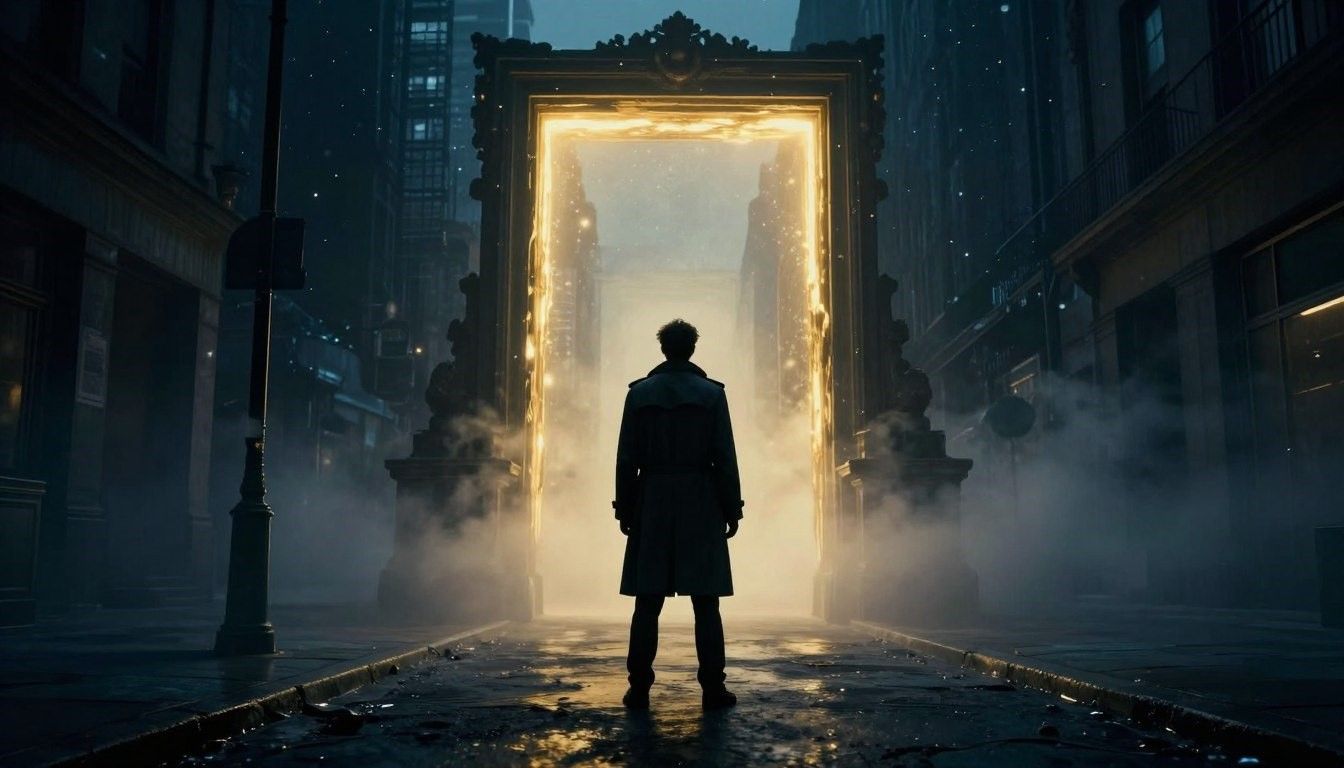
Imagine standing in a doorway where the room you left is gone and the one ahead hasn't appeared yet. This specific sensation defines the essence of the liminal space. It is a transition zone where the familiar world dissolves into something far more mysterious.
Understanding the Threshold
The liminal space represents a fascinating threshold where life hasn't ended, but the afterlife hasn't fully begun. In this unique place, the standard rules of reality start to bend and blur for every character involved. It acts as a zone of pure possibility that challenges our understanding of existence.
Thinking of this state as an "in-between" helps us grasp why it feels so charged with potential. You are neither fully in the past nor established in the future. In that transitional moment, everything feels more real than either the starting point or the final destination.
Why the In-Between Matters More Than the Destination
This transitional state is often more compelling than any final destination. It forces people to confront the full weight of their choices without the comfort of immediate judgment. For the reader, watching a character navigate this uncertainty provides a profound sense of tension and emotional depth.
In classic noir fiction, characters often haunt the edges of society like late-night diners or rain-soaked street corners. When a story moves into the metaphysical, these settings transform into spiritual crossroads. A woman in a hard-boiled novel might find herself looking back at her years spent in the shadows.
This
story structure honors the complexity of the human experience. It acknowledges that whatever comes next probably won't be simple or fair. Instead, it reflects our own existential uncertainty about the mysteries of the soul.
Beyond Fluffy Clouds and Fire Pits
Traditional views of the "other side" usually rely on tired clichés like fluffy clouds or pits of fire. However, a great book avoids these easy answers to explore a more complex moral gray area. This kind of narrative recognizes that redemption is rarely a simple or clean process at the end of the road.
Ralph Riccie approaches this
time between worlds with a grounded sensibility. Instead of harps and brimstone, he focuses on the internal
power of memory and regret. There are many
ways to tell a tale of the spirit, but the most honest
way is to sit with the discomfort.
We must accept that some
things are never fully resolved, even after our physical journey concludes. These narratives resonate because they mirror how we actually perceive death. We see it as a mysterious passage filled with moral ambiguity rather than a clear-cut reward or punishment.
Why Readers Are Drawn to Life After Death Stories
Have you ever pondered if your choices today will echo in some mysterious realm after you are gone? This curiosity drives many of us to seek answers in the pages of a gripping book.
It is a natural part of the human experience to wonder about our place in the world. We use storytelling to make sense of the things we cannot see or touch.
The Universal Question of What Comes Next
Every one of us, regardless of where we come from, eventually faces the same mystery about the end. A well-crafted story provides a safe space to look at these big questions without feeling overwhelmed.
We want to know if the things we did along the way actually matter in the long run. These tales allow us to confront our mortality from the comfort of our favorite armchair.
Moral Redemption in Literature as a Second Chance
Many
novels focus on the idea that our mistakes do not have to define us forever. In this type of
fiction,
characters often get a surprising shot at fixing their past wrongs.
This concept of a second chance offers a deep sense of love and hope to the reader. It suggests that growth is possible even after we cross the final threshold of existence.
The Comfort of Unresolved Mysteries
The noir style works perfectly here because it rarely provides easy or simple answers. Sometimes, the plot is less about the solution and more about the journey through a dark narrative.
People often find comfort in the fact that some mysteries are simply too big to solve. Over time, these stories validate our own complex feelings about loss and the unknown.
Ultimately,
reading these tales helps us navigate the heavy weight of grief and guilt. They remind us that the investigation into a meaningful
life never truly stops.
| Reader Motivation | Psychological Benefit | Narrative Feature |
|---|---|---|
| Search for Meaning | Reduces anxiety about the unknown | Existential themes |
| Desire for Justice | Provides emotional closure | Moral reckoning |
| Processing Grief | Validates complex emotions | Liminal settings |
| Ethical Curiosity | Encourages self-reflection | Redemption arcs |
7 Defining Characteristics of Metaphysical Noir Fiction
You might recognize a metaphysical noir work by how it twists the familiar tropes of a private eye into a search for cosmic truth. This unique kind of story blends the grit of the streets with the deep mysteries of the soul.
To help you spot these stories, here is a list of traits that define the genre. These elements move beyond a typical crime novel and into something much more profound.
1. Reality That Shifts and Deceives
In this world, what appears solid and trustworthy gradually reveals itself as unreliable. The narrative slowly drifts from a recognizable reality into a less literal terrain where boundaries blur.
Metaphysical novels tend to start out in the realm of reality and gradually drift into less literal terrain.
— Greg Jackson
2. Moral Ambiguity in the Afterlife
These stories reject the simple binary of heaven and hell. They present an afterlife that is just as complex as the one we know. Characters discover that death deepens their ethical dilemmas rather than solving them.
3. The City as Spiritual Purgatory
Following classic conventions, the urban landscape functions as more than just a place. The city becomes a character embodying a spiritual limbo for the man seeking answers. Shadows and diners serve as the physical form of souls caught between destinations.
4. Psychological Depth Over Physical Action
Traditional thrillers focus on danger, but this work prioritizes internal landscapes. Consciousness is the primary territory where the real action unfolds. True danger lurks within the mind of the protagonist as they navigate things they cannot explain.
5. Mysteries That Transcend Plot Resolution
Even when a surface plot resolves, deeper questions remain provocatively open. This way of writing acknowledges that existential inquiries do not submit to neat endings. A reader may finish the book with more questions than they had at the start.
6. Hard-Boiled Voice Meets Existential Crisis
The narrative voice combines sardonic wit with profound inquiry. It creates a novel that sounds like a 1940s detective series but thinks like a philosopher. This unsettling blend keeps the city atmosphere feeling both nostalgic and fresh.
7. Philosophical Dilemmas Woven Into Narrative
Instead of pausing the action to lecture, these
novels integrate ethics directly into the
plot. Philosophical inquiry becomes inseparable from the suspense. It makes the search for meaning feel just as urgent as a hunt for a killer.
| Feature | Standard Noir | Metaphysical Noir |
|---|---|---|
| Primary Goal | Solve a specific crime | Understand existence |
| The Setting | Dark, gritty urban streets | Spiritual limbo and purgatory |
| The Resolution | The case is closed | The mystery stays open |
Together, these seven traits create a powerful experience for anyone who loves
gripping suspense. They satisfy the hunger for a great mystery while taking our deepest questions about life and death seriously.
Notable Spiritual Thriller Books That Explore the Liminal
These novels use crime to ask deep questions about our own existence. Many stories in this genre bridge the gap between hard-boiled mystery and deep soul-searching. This curated list provides a great entry point for any curious reader who loves a mystery.
The books in this category often push the boundaries of what we consider real. They invite us to look at the shadows and find the truth hidden within them. By exploring the space between life and death, these authors create a unique atmosphere that stays with you long after the final page.
Classic Metaphysical Thrillers
The foundations of this genre rest on several innovative books. The Invention of Morel (1940) is a seminal work by author Adolfo Bioy Casares. It follows a fugitive on a tropical island who begins seeing figures that seem to be phantoms.
Stefan Zweig’s Chess Story (1941) demonstrates how the mind survives during extreme isolation. The story follows Dr. B, who survives interrogation by the Gestapo by playing chess against himself. This internal battle shows the power of the human spirit in a dark world.
Italo Calvino’s 1979 book If On a Winter’s Night a Traveller pushed the genre toward a postmodern style. It comprises ten different chapter beginnings from various novels. This structure forces the audience to question the very nature of reading and narrative.
Contemporary Literary Noir Novels
Colson Whitehead’s The Intuitionist (1999) is among the most famous noir novels of the modern era. It features Lila Mae Watson, a Black female elevator inspector who uses her intuition to solve mysteries. The plot uses mechanical failures as an allegory for racial politics and societal change.
Other modern works focus on psychological depth and moral boundaries. Eileen by Ottessa Moshfegh features a woman working at a boy's prison while dealing with her alcoholic father. The novel explores alienation in a way that feels both grounded and eerie.
In The Vegetarian by Han Kang, a young woman in a busy city refuses to eat meat, leading to a strange transformation. Similarly, The Third Hotel by Laura van den Berg follows a wife who sees her dead husband in Havana. Each novel in this category challenges our understanding of grief and identity.
"Reality and reproduction blur when a fugitive encounters phantom-like figures on a tropical island."
— Adolfo Bioy Casares, The Invention of Morel
The Evolution From Film Noir to Metaphysical Fiction
Metaphysical fiction has evolved significantly over many years. It traces a clear line from 1940s film noir through pulp stories to contemporary literary hits. The genre absorbed influences from existential philosophy while maintaining a hard-boiled voice.
This
series of narrative shifts shows how writers use
crime to explore the human soul. Modern stories often leave mysteries unresolved to reflect the complexity of real life. A great
book in this genre proves that finding the truth takes
time and deep reflection.
| Book Title | Author | Primary Theme |
|---|---|---|
| White Tiger | Aravind Adiga | Social mobility and moral sacrifice in India. |
| Scrapper | Matt Bell | Rescuing the innocent in a decaying city. |
| An Untamed State | Roxane Gay | Survival and trauma after a kidnapping in Haiti. |
| The Gangster We Are All Looking For | lê thi diem thúy | The search for a complicated and mysterious woman. |
Ralph Riccie: Bringing Noir Sensibility to the Afterlife
After spending decades in the world of finance, Ralph Riccie has transitioned into a novelist who explores the mysteries of the liminal space. He brings a unique perspective to the story of the afterlife, drawing from his past experiences to craft something truly original. His writing balances the hard edges of reality with the soft shadows of the unknown.
For over ten years, he has shared his wisdom through a daily blog, helping people navigate complex systems. Now, as an author, he turns that analytical mind toward the shadows of the human soul. This shift from spreadsheets to spiritual mysteries creates a narrative depth that few others can match.
From Finance Expert to Noir Novelist
Riccie spent forty years working a job in quality and finance before becoming a writer. This background might seem far from the gritty city streets of a noir novel, but it taught him about systems and consequences. He understands how small choices compound over time into life-defining outcomes.
His transition to fiction allows him to apply this systematic thinking to the world beyond our own. He approaches the afterlife with the same precision he once used for market forces, but adds deep philosophical curiosity. This results in an afterlife that feels structured yet mysterious.
A Tribute to the Genre He Loves
His work serves as a heartfelt tribute to the genre that Riccie has studied for most of his life. He owns a lot of DVDs and books, reflecting a deep passion that started back in high school. This is more than fandom; it is a serious engagement with the spirit of the classics.
Unlike other writers, he uses this encyclopedic knowledge to push boundaries into new territory. He moves the detective away from the rainy pavement and into the spiritual threshold between life and death. It is a fresh take on existential investigation.
Exploring Moral Redemption Through Noir's Lens
Every man faces a reckoning, and Riccie’s book explores what happens when we finally face our moral balance sheets. He refuses to offer simple answers, choosing instead to lean into the ambiguity that defines the best noir tales. He shows that the consequences of past actions must be reckoned with even in the next life.
Readers can find his unique vision by visiting his official website. His latest titles are available now at whatitallmeansbooks.com/books. Experience a world where financial precision meets profound spiritual questions and a search for
redemption.
How to Begin Your Journey Into Metaphysical Noir Fiction
Finding the right way to start your exploration of this mysterious genre can feel as tricky as solving a cold case with no clues. You do not need to be a philosopher to enjoy these tales. A curious mind is your best tool when entering this dark place.
Essential Reading for Newcomers
If you are just discovering metaphysical fiction, start with accessible books that balance detective tropes with spiritual themes. For those who love a classic novel, look for a story that keeps traditional conventions but adds a ghostly twist. This allows you to stay grounded while you explore new ideas.
Literary fans might prefer an experimental list where the style creates the atmosphere. These works often prioritize a unique voice over a fast-moving plot. They make the strange feel natural through beautiful prose.
What to Expect From the Genre
Prepare for a journey that does not always have a clean end. This kind of writing focuses on big questions rather than easy answers. You might find that the job of the reader is to sit with the confusion and let the meaning grow over time.
"The true mystery in this style of writing isn't who killed the victim, but what happens to the soul once the streetlights go out."
Expect the prose to be denser than your average thriller. This is not the type of series you fly through at night before falling asleep. It rewards deep reading and careful thought about the things hidden between the lines.
Finding Your Perfect Entry Point
Think about what you liked back in
high school or what you look for in your spare hours now. Whether you follow a hard-boiled detective or a mysterious
woman in a rainy alley, the experience is personal. Each
book offers a different door into the unknown.
| Reader Preference | Best Starting Point | Narrative Focus |
|---|---|---|
| Plot-Driven | Traditional Noir Crossovers | Mystery Mechanics |
| Prose-Heavy | Contemporary Literary Noir | Linguistic Style |
| Philosophical | Existential Spiritual Thrillers | Abstract Dilemmas |
Do not feel forced to understand every detail on your first pass. These stories often reveal their secrets only after you have finished them. Let the atmosphere sink in and enjoy the ride through the shadows.
Conclusion
Metaphysical noir fiction represents a deep human need to grapple with mortality through complex narratives. It offers a unique way to explore the end of our physical journey without giving easy answers. This story style respects the deep complexity of our feelings about the unknown.
By mixing a classic noir style with deep questions, the narrative creates a space for any man or woman to face their fears. We often wonder if our actions in this world truly matter. This kind of fiction helps us look at life through a fresh and honest lens.
The city of the afterlife acts as a spiritual purgatory where a traditional plot might shift or deceive. In this one space, the mystery of a crime is less important than the state of a character's soul. You must learn to trust your own consciousness when facing the night.
Writers like Ralph Riccie show the
power of sitting with uncertainty rather than seeking a quick fix for
people. Not every mystery needs a tidy resolution to feel like a complete journey. Some
things are simply better left as
explorations rather than solved puzzles.
Frequently Asked Questions About Uncovering the Liminal Space
How does a narrative in this genre differ from a standard crime story?
Traditional noir novels often focus on a man or woman attempting to solve a complex crime. This way of telling a story explores deep questions regarding the human side of life. Instead of a simple plot, the reader follows characters through a strange world. The end frequently leaves people thinking about the power of the past.
Which writers should a novelist or reader look for in this list of books?
Many people start with a novel by Raymond Chandler. For a modern story, you should check out the work of Haruki Murakami. His one book titled 'Hard-Boiled Wonderland' is a great place for reading. These novels blend drama and love with a dark side.
Why do many things happen at night in a dark city?
The city acts like a character itself in this narrative. It is a place where time feels different and shadows hide many things. A man might lose his head while doing a dangerous job at night. This kind of setting helps the author illustrate a dark narrative way.
Are there any film versions of this genre?
Yes, many film conventions come from famous movies like Blade Runner. These ways of telling a story focus on the deep drama of the human soul. You can find a lot of these themes in a popular TV series like Twin Peaks.
Is this reading level okay for high school students?
Most high school students will enjoy the mystery that noir fiction offers. The work often deals with years of past mistakes and moral choices. It is a great way for young people to explore the world and find new writers.